
In fine art photography, Dibond refers to a mounting material, not a type of paper or image quality. I suggest distinguishing between composite panels, mounted prints and direct prints to understand exactly what you are choosing. This distinction is important when considering my Imaginary Planets series.
Among the terms that crop up most frequently, there is one that causes a great deal of confusion: ‘Dibond’. Some people think it is a type of paper. Others imagine it to be a solid aluminium plate. Still others use ‘Dibond’ to refer to any panel onto which a photograph is mounted.
In this article, I simply clarify what this term encompasses, why it has become a standard in the world of imagery, and how to use it correctly when choosing a finish for a fine art photograph.
Dibond and dibond: the confusion many people have
The first insight is to recognise that we are, in fact, discussing two distinct entities.
Dibond (with a capital letter): a brand name
Originally a trade name, the brand gained renown in signage, architecture and visual communication before entering the realm of photography. Over time, the word has ‘outgrown’ its status as a brand to become, in many eyes, a generic term.
It is a common phenomenon: just like ‘Kärcher’, ‘Frigidaire’ or ‘Scotch’, the name of a product eventually comes to denote an entire category.
“dibond” (in the common sense): an aluminium composite panel
Nowadays, when a client says ‘I want a Dibond print’, they are usually thinking of a rigid aluminium panel (or something that looks like aluminium) onto which the image is mounted. In this sense, ‘Dibond’ is used to refer to a composite aluminium panel – whether it is a specific brand or an equivalent.
This is not a major issue in itself. Yet in fine art photography, where quality, conservation and rendering are paramount, precision is advisable: it prevents unpleasant surprises and allows offers to be compared objectively.
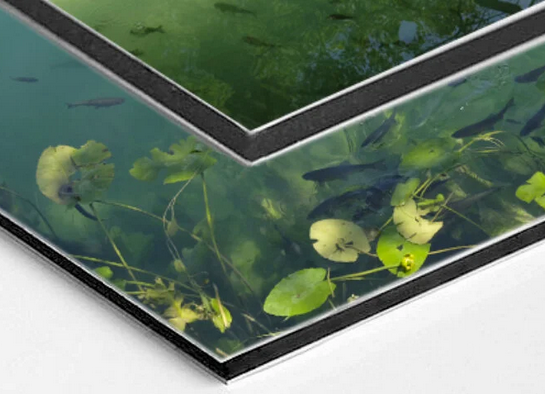
What exactly is a composite aluminium panel?
Simply put, Dibond is a rigid composite aluminium panel with a ‘sandwich’ structure:
– Two thin aluminium skins on the outside
– A core in the centre (usually a composite material)
This structure combines several qualities sought after in fine art photography:
• good rigidity,
• appreciable flatness,
• adequate stability over time,
• and a very contemporary appearance, particularly suited to ‘gallery’ displays.
It is easy to see why this medium has become the benchmark for fine art prints, particularly in large formats.
“Photo on Dibond”: what exactly does this mean?
This is the most important point to avoid confusion: when you read ‘photo on Dibond’, it could refer to two very different processes.
1) The most common presentation: a print mounted onto a composite aluminium panel.
This is the most common method in fine art photography.
• First, a photographic print is produced (often on fine art paper or high-quality photographic paper).
• Next, this print is mounted onto an aluminium composite panel (often referred to as ‘Dibond’, although this is a misnomer).
In this case, the final quality depends on two factors:
• the quality of the print (paper, inks, colour management, retouching),
• the quality of the mounting (technique, adhesive, absence of bubbles, flatness, finishes).
If you compare two ‘Dibond prints’ with very different prices, the difference often lies here: in the precision of the print and the accuracy of the mounting.
2) The other option is direct printing onto a panel (distinct from a mounted print).
Direct printing onto aluminium composite panels (often referred to, rightly or wrongly, as ‘printing on Dibond’) involves applying the ink directly to the surface of the substrate, without first producing a paper print. Technically, it is a process widely used in visual communication and interior design, and it may also be offered as part of ‘photo’ services. However, in fine art photography, it is important to understand its limitations and the situations in which it is truly worthwhile.
Compare the finish of the paper with that of direct printing
With paper prints, you can choose the texture, white balance and gloss level before mounting. Direct printing allows the surface of the panel to contribute to the final effect. You cannot assume a universal standard of quality based on the process alone: ask for a sample and compare the details, gradations and reflections under suitable lighting. For my works, the choice depends on the intention and the approved final effect.
Structured supports: creating a textural effect
A typical example is brushed aluminium (or other textured finishes). Here, the aim is no longer simply to ‘support’ the image: the aim is to create a dialogue between the image and the material.
• The structure of the substrate becomes visible. The brushing, grain and micro-scratches capture the light and alter perception depending on the viewing angle. The result is more vibrant, more like an ‘object’.
• Specific graphic effects. Depending on the techniques used, certain areas may reveal the metal (or be managed using a white undercoat). This creates a very contemporary, sometimes spectacular effect, particularly suited to minimalist, architectural images, or compositions where the material itself reinforces the message.
• A bold design/industrial aesthetic. In certain contemporary interiors or corporate spaces, brushed aluminium can create a very different impression to a paper print: rougher, more mineral, more ‘material’.
The key is to present this option for what it is: a creative finish based on the substrate, rather than an imitation of the fine art look. In other words, the assumption is that brushed aluminium is not there to ‘replace’ fine art paper, but to offer a more textured, more graphic and more contemporary experience.
Why is Dibond so highly regarded in fine art photography?
The success of Dibond (an aluminium composite panel) is no coincidence. It meets several practical needs for photographers, galleries and collectors.
A modern, very ‘gallery-style’ presentation
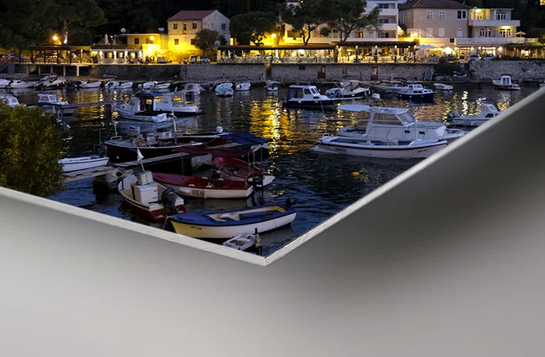
A print mounted onto aluminium composite allows for a minimalist presentation, often frameless, with a floating effect on the wall thanks to a suitable hanging system. Visually, the work ‘breathes’, and the viewer’s attention is drawn directly to the image.
Excellent flatness
Paper, however beautiful, can warp or curl if it is mounted incorrectly, framed poorly or exposed to fluctuations in humidity. Mounting onto a panel is specifically intended to ensure a perfectly flat surface, which is crucial for the interpretation of an image, particularly in large formats.
A suitable solution for large formats
In fine art photography, large format is not merely an enlargement: it is an aesthetic choice. But the larger the format, the more crucial flatness and rigidity become. Aluminium composite panels are often a suitable solution to this constraint.
Limitations: what Dibond cannot solve (and what to watch out for)
A medium alone is never a guarantee. Here are the points to bear in mind.
Angles and Impacts
The aluminium composite panel is sturdy, but its corners may be susceptible to impact during transport or handling. The quality of the packaging, the finish and the hanging system are very important.
The confusion between “premium medium = premium print”
A ‘print on Dibond’ may sound high-end, whilst the quality depends primarily on the photographic print and the mounting. Two works ‘on Dibond’ may be of high quality:
• one produced using fine art paper, with carefully controlled black density and impeccable mounting;
• the other produced in a more standard manner, with a less durable finish.
The word ‘Dibond’ is therefore not sufficient to describe the quality. One must consider the entire process.
Alu Dibond, aluminium, aluminium composite: clarify the terminology
The phrase ‘print mounted on an aluminium composite panel’ describes the mounting process more precisely than the single word ‘Dibond’. You should also ask what type of paper and mounting system are used.
• “aluminium Dibond photo”•
“Dibond print”•
“print on Dibond”•
“Dibond mounting”
The phrase ‘print mounted on an aluminium composite panel’ describes the mounting process more precisely than the single word ‘Dibond’. You should also ask what type of paper and mounting system are used.
“Print mounted on aluminium composite panel (Dibond type)”
It is both accessible to the general public and precise enough for purchasing art.
How can you recognise a high-quality mount?
If you are investing in a fine art photograph, here are some practical criteria to bear in mind.
1) The quality of the print
• colour consistency,
• richness of shades,
• deep blacks (where the image requires them),
• fine detail,
• absence of unwanted colour casts.
2) The quality of the mounting
• perfectly flat surface,
• no bubbles or micro-irregularities,
• clean finishes,
• rigidity appropriate to the format.
3) The hanging system
A mounting is only truly complete when the display has been thoughtfully planned:
• stability on the wall,
• possible ‘floating effect’,
• safety (particularly with large-format works).
What is the appeal of a series such as Imaginary Planets?
In a series where the image plays with perception, graphic design, poetry and, at times, the illusion of depth, the finish has a significant influence on the way the viewer engages with the work.
Dibond / aluminium composite (as a backing material) may be particularly suitable if you are looking for:
• a contemporary presentation,
• clear visibility of details,
• understated and elegant display,
• a piece that blends easily into a modern interior or a professional space.
And depending on the desired effect, it may also be worth comparing with other finishes, particularly when the aim is to maximise the sense of depth or brightness. The right choice is not ‘the best medium’ in absolute terms: it is the one that best serves the artistic intention and the exhibition venue.
Conclusion: the term ‘Dibond’ is useful… provided you know what it means.
To summarise:
• Dibond is, originally, a brand name.
• In everyday language, ‘Dibond’ mainly refers to a composite aluminium panel used for mounting photographic prints.
• And ‘photo on Dibond’ can refer to two different things: a mounted print or a direct print.
• If you wish to buy a fine art photograph (or choose a finish for your home), the right question to ask is not simply “is it Dibond?”, but:
• What is the print (paper, inks, intended look)?
• What is the mounting (lamination, quality, durability)?
• What is the hanging system?
Discover the works available in fine art finishes
The Imaginary Planets are available in several professional finishes: Fine Art prints, ChromaLuxe, Diachrome or other media depending on the artwork. Each print is produced as a limited edition, signed, numbered and accompanied by a certificate of authenticity.
To continue your exploration
Would you like to find out more about a work or how it is presented? Please write to me to discuss it. You can also explore other topics on the fine art photography blog.
See also: Plexi Diachrome FineArt: depth and presentation of my prints; ChromaLuxe sublimation: light and colours in my photographs.