
There are moments when an image transcends the confines of a digital file, a screen or a conventional print to become something else: a material, a surface, a presence. That is exactly how I felt when I discovered my first ZeroChrome-SbQ print, produced by Frédéric Materne. This alternative photographic process gives one of my Imaginary Planets a new presence, created through an interplay of pigments, paper and light.
This exploration of materials builds on the creation of my Imaginary Planets. To uncover further relationships between paper and image, I also present Awagami papers and the nuances of black and white in piezography: different approaches that shed light on my choices regarding prints.
For several years now, my artistic work has centred on the ‘Imaginary Planets’, a series of photographs transformed into circular worlds, recomposed landscapes and suspended universes. These creations arise from the interplay between the act of taking the photograph, digital transformation, composition and poetic intuition. Yet a photographic work is not confined to the image alone. It also exists through its medium, its finish, its format, its texture and the way it captures light.
It was whilst exploring the photographic object that I felt drawn to experiment with ZeroChrome-SbQ, an alternative photographic process related to pigment prints. For this first experiment, I entrusted the production of the print to Frédéric Materne, a photographer, specialist in the gum bichromate process and lecturer at the Royal Academy of Fine Arts in Liège. His expertise enabled me to apply my visual language to a demanding technique, in which pigment, light, paper and manual skill play an essential role.
This first print will be presented this autumn in an exhibition in Brussels. For me, it marks an important milestone: that of a dialogue between contemporary photography, revisited traditional processes and the materiality of the fine art print.
What is the ZeroChrome-SbQ process?
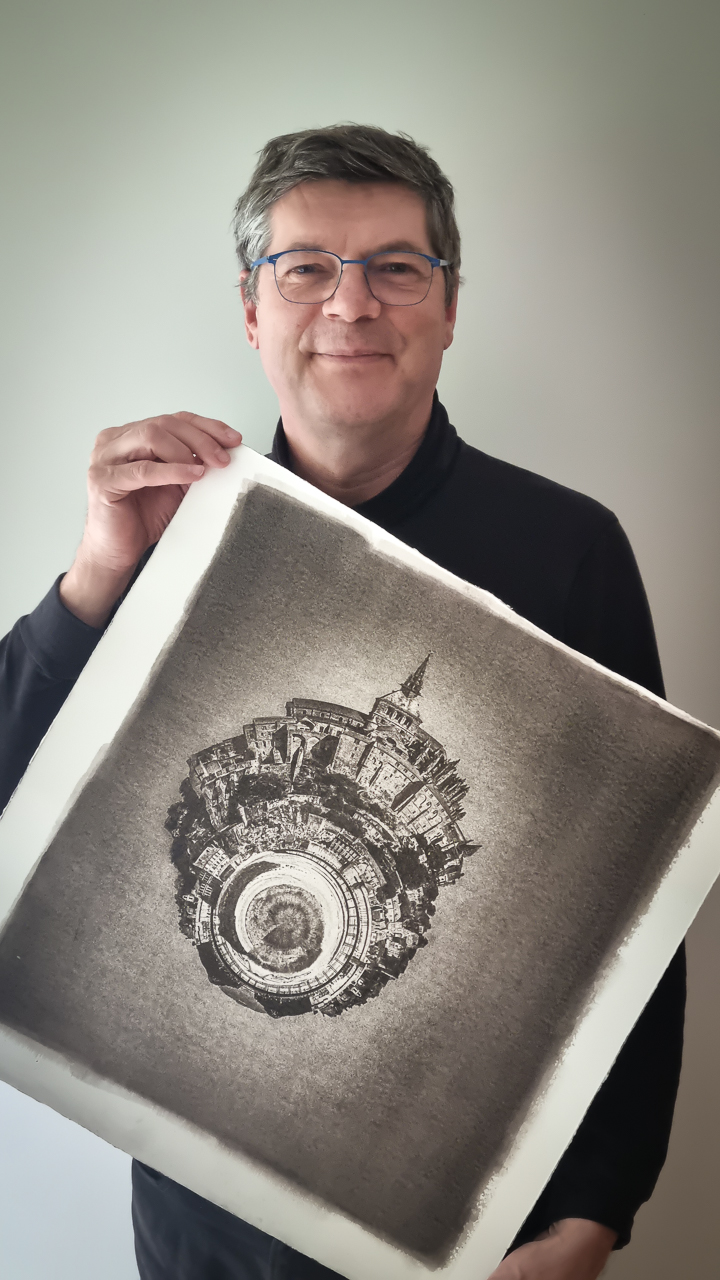
ZeroChrome-SbQ is a pigment printing process that forms part of the wider family of alternative photographic processes. In spirit, it can be likened to techniques such as gum bichromate, casein or certain direct carbon processes. In all these cases, the image does not appear through conventional inkjet printing, but through the action of light on a light-sensitive layer composed of a binder and pigments.
The general principle is fascinating. A pigmented, light-sensitive layer is prepared and applied to a substrate, often a suitable type of paper. This layer is then exposed through a negative or a contact device. The areas exposed to light react differently from those that remain protected. During development, usually using water, the image gradually emerges.
The ZeroChrome-SbQ process is distinguished by its aim to offer an alternative to the chromium salts historically used in certain pigment-based processes, notably gum bichromate. The name of the process itself makes this clear: ‘ZeroChrome’ refers to the idea of a chromium-free process. The SbQ, meanwhile, relates to a photosensitive chemistry that makes the binder light-reactive.
Simply put, ZeroChrome-SbQ allows me to create a photographic image with pigments, bypassing the chromium salts long linked to certain historical processes. This does not mean one can pursue such techniques without knowledge or caution, but it does open an intriguing path for artists and printmakers eager to explore more contemporary pigment-based processes.
ZeroChrome-SbQ and bichromate gum: a connection
To understand the appeal of ZeroChrome-SbQ, we must look back at the bichromate gum process. This historic process, which emerged in the 19th century, is based on a mixture of gum arabic, pigment and chromium salts. When exposed to light, this mixture hardens to varying degrees depending on the area, allowing an image to be revealed during development.
The gum bichromate process holds a special place in the history of photography. It has often been favoured by pictorialist photographers, but also by artists drawn to a more manual, more interpretative and less strictly mechanical approach to photography. Each print can be different. The choice of pigment, the density of the layers, the paper, the exposure time, the development process and the printer’s technique all influence the final image.
The ZeroChrome-SbQ embodies this same sensibility: that of a form of photography which embraces slowness, nuance, human intervention and the unexpected. Yet it offers a contemporary approach, replacing chromium salts with a different photosensitive chemical process.
It is precisely this link between tradition and innovation that has interested me. ZeroChrome-SbQ does not simply seek to imitate an old process. Rather, it allows us to continue a story: that of images made of light, pigment and patience.
Why this process interests me as a fine art photographer
My work on the Imaginary Planets series is based on a transformation of reality. I start with a photograph, often captured in a landscape, an urban setting, a natural environment or an architectural space. The image is then recomposed, curved, inverted and manipulated until it becomes a planet, a self-contained world, a poetic form.
This process may seem very contemporary, almost digital in nature. Yet, at its core, it touches on a much older question: how does an image become a work of art? Is it through the gaze? Through the composition? Through the subject? Through the print? Through the material?
In my artistic practice, I also wish to explore other avenues and other media through which to bring my creations to life.
With the ZeroChrome-SbQ, this question takes on a very tangible form. The image is no longer merely defined by the final file. It is embodied in a pigment-based material. It is built up in layers, through exposure, and through reaction to light. It becomes a photographic object in the truest sense of the word.
What appeals to me about this approach is the return to a form of slowness. In a world saturated with fleeting images – shared, viewed and then forgotten – the pigment print imposes a different rhythm. It compels us to look differently. It invites us to consider the image as a physical presence, almost fragile, yet also profoundly enduring.
My ZeroChrome-SbQ print produced by Frédéric Materne
For this first experiment, I chose to work with Frédéric Materne, whose experience of traditional processes, particularly gum bichromate, was essential. The ZeroChrome-SbQ process requires a detailed understanding of the relationship between pigment, binder, light, support and development. It is not simply a matter of ‘producing’ an image, but of guiding its emergence.
This collaboration is important to me. In the field of fine art printing, the role of the specialist printer can be decisive. The artist contributes an image, an intention, a world. The printer contributes technical mastery, knowledge of the process, and the ability to translate that intention into a physical form.
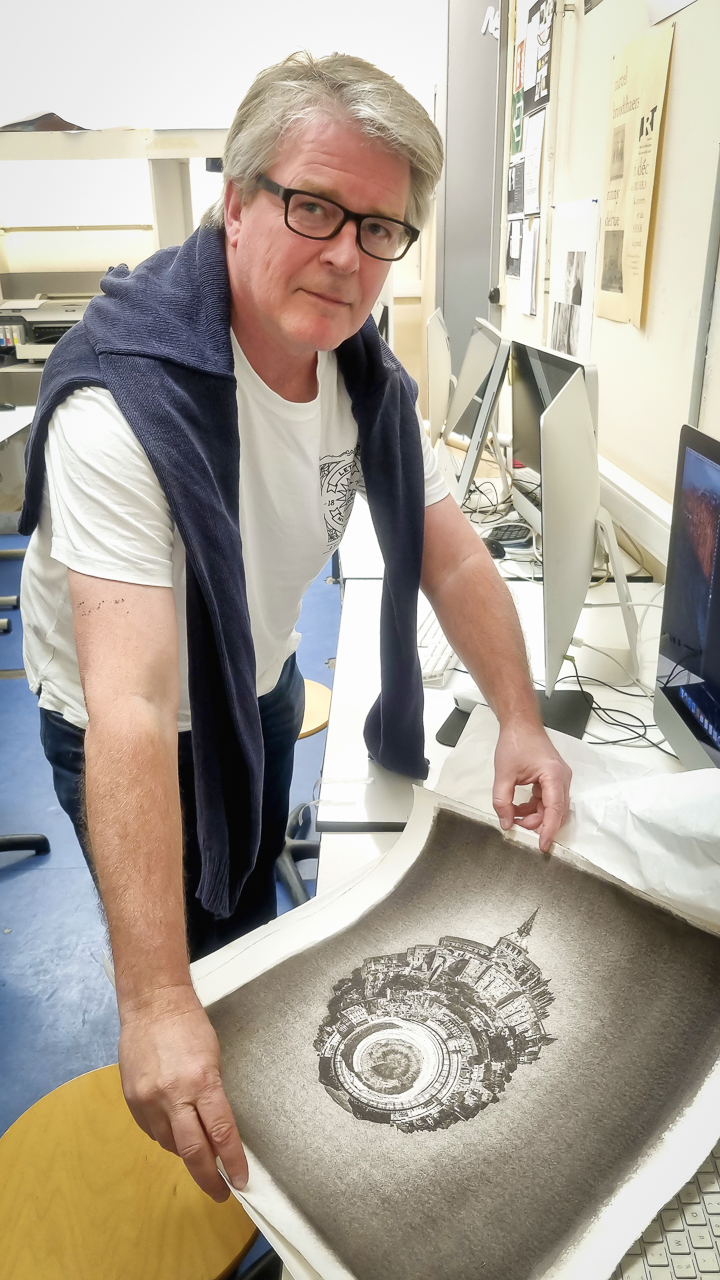
The print then becomes the result of a dialogue. It does not betray the original image; it interprets it. It gives it a different depth, a different vibration, a different way of existing.
In my case, this encounter with ZeroChrome-SbQ has allowed me to see my work in a different light. An Imaginary Planet printed through this process does not evoke the same sensation as a traditional fine art print or a contemporary finish such as ChromaLuxe. It seems to belong to another era. It retains the contemporary aspect of the image, but sets it within a medium that is slower, quieter and more artisanal.
Photography, pigment and light
What fascinates me about this first print is the way it brings together three fundamental elements: photography, pigment and light.
Photography, first and foremost, because everything stems from an image. Even when transformed, even when recomposed, even when it has become a planet, the work retains a link with reality. It comes from a place, a moment, a glance.
Then there is the pigment, because colour is no longer merely a digital datum or ink applied mechanically. It becomes a material. It has a depth, a presence, a direct relationship with the paper. The pigment gives the print an almost pictorial quality, without, however, taking it out of the realm of photography.
Light, finally, because it plays a part at several stages. It is present when the photograph is taken. It is present in the transformation of the image. Above all, it is present in the process itself, since it is light that acts upon the light-sensitive layer and contributes to the development of the print.
It is this cycle that interests me: light captures the world, then light reveals the image once more on the paper. In between, there is the artist’s gaze, the printer’s craftsmanship and the memory of the pigment.
A new phase in my artistic work
This first ZeroChrome-SbQ print does not replace the other finishes I usually offer for my fine art photographs. My works continue to be available as fine art prints, in contemporary finishes, as limited editions and in various formats. Yet this experiment opens up a new path.
It allows me to explore photography as a medium, as a trace, as a unique or almost unique object. It leads me to reflect on how the same image can change in nature depending on the process used. A work of art is not merely its subject or its composition. It is also the way in which it is produced, printed, developed and presented.
I am drawn to the ZeroChrome-SbQ because it bridges several dimensions of my practice: digital transformation, fine art photography, the history of processes, the deliberate slowness of printing and the physical presence of the artwork.
This is an avenue I wish to continue exploring.
A print exhibited in Brussels in the autumn
This first ZeroChrome-SbQ print will be presented this autumn at an exhibition in Brussels at the Louise Linthout Gallery. I shall then have the opportunity to show it to the public, not only as an image drawn from my world of Imaginary Planets, but also as a photographic work produced using a rare and demanding process.
I like the idea that this work can be viewed on several levels. One might see it as an Imaginary Planet, a poetic image, a circular world. One might also see it as a pigment print, a textured surface, or an encounter between a contemporary image and an alternative photographic process.
This exhibition will therefore be an opportunity for me to share a new stage in my artistic exploration. It will reveal something of my relationship with photography: a form of photography that is not limited to the captured moment, but which continues to live on in the choice of medium, in the material of the print and in the way the work meets the viewer’s gaze.
Conclusion: from the image to the photographic object
With this ZeroChrome-SbQ print, I feel I have reached a new stage. Not a break, but a deepening.
From the very beginning, my Imaginary Planets have sought to transform reality into a poetic universe. Through this process, this transformation extends into the very material of the print itself. The image is no longer content merely to be seen. It is touched by the gaze. It exists as a surface, as pigment, as fixed light.
Perhaps that is what fascinates me most about this experience: the feeling that photography can still surprise us, even after so many years of digital images, high-definition files and flawless prints. It can once again become slow, experimental, sensitive, almost alchemical.
This first ZeroChrome-SbQ print is therefore more than a technical experiment. It is an encounter. An encounter between my artistic world, Frédéric Materne’s expertise, the legacy of traditional processes and the contemporary possibilities of photographic printing.
An encounter between photography, pigment and light.