
Discover my Imaginary Planets in interior settings through this gallery of stylised scenes. Here, my photographic creations encounter different spaces, colours and materials. Each example offers a way of looking at the work and imagining the place it might occupy in your everyday life.
The interior scenes in this gallery are display simulations designed to help you visualise how the works might look in your space. The scale, lighting and appearance may vary depending on the location, format and finish chosen. The artwork descriptions detail their specifications; I can assist you in planning a personalised project.
If you wish to pair an artwork with your space, my article on hanging and showcasing a fine art photograph offers guidance on selection and display.
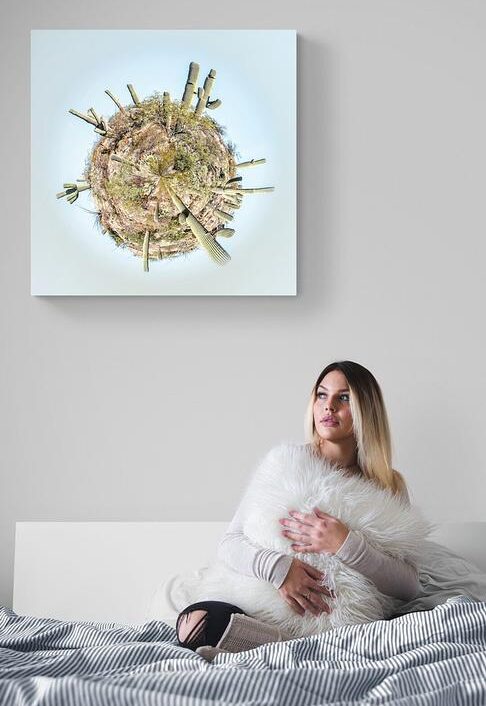
Two perspectives on a personal space
The luminous composition of Éclairée and the vegetal presence of Monde Aride open up two distinct worlds. Whether in my studio or in a bedroom, my priority is always the encounter between an image and a sensibility.

Marine Blue and Pink Corals
Day Cargo and A Coral Dream demonstrate how my Imaginary Planets can interact with the surrounding colours. One brings a blue universe to life, whilst the other introduces more vibrant shapes and colours.

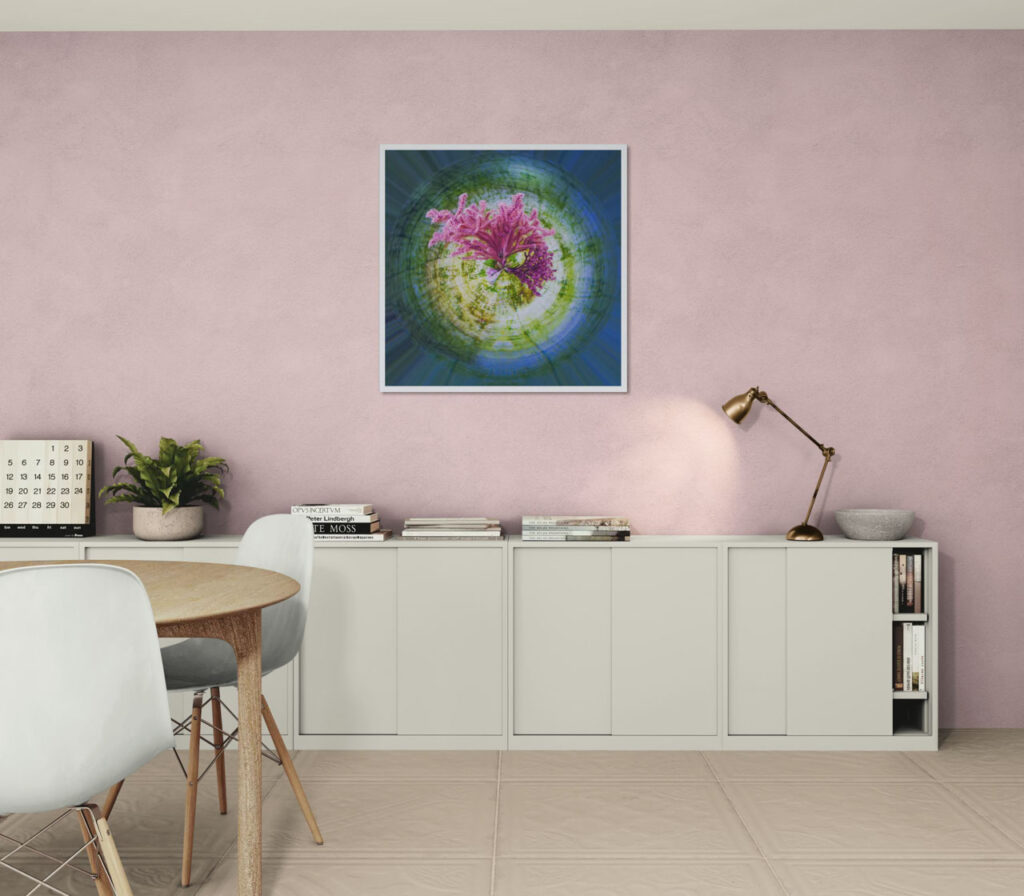
Indoor Imaginary Planets: plant life
The Green Swirl and This Way offer two approaches to depicting the landscape. The circular movement or the line drawn across the field becomes a focal point within the space.


Lines, Curves and Materials
The interwoven structure of Woven Light and the wave-breakers in Proud! echo the lines of the furniture and architecture. The artwork can complement these lines or introduce a contrast.


From One Palette to Another
‘Water Lily of Light’ features intense greens and a touch of pink. ‘The Lonely Tree Revisited’ offers a softer interpretation, in pastel shades. These presentations invite you to compare the emotions and atmospheres they evoke.


A warm presence, a monochrome style
‘Regeneration’ features golden and orange hues. The black-and-white interpretation of Angkor Wat offers a different perspective on my work, focusing on forms and contrasts.


Imagine one of my works in your home
If a particular piece catches your eye, please contact me with its title and the dimensions of your space. We can then discuss presentation options, available finishes and how it will complement your interior.
To learn more about the project, explore the formats of Imaginary Planets, or continue your tour of the gallery. My photographs are available as limited editions, each signed and numbered and accompanied by a certificate of authenticity. To compare colour palettes, browse the works in blue, green or pink, then the selections in red, yellow and those in which black structures the composition.
To help you determine the dimensions of your display space, my guide to the size of an art photograph per room suggests trying out a template. The formats for Imaginary Planets then outline the options to consider for each work.
From observing a simulation to choosing a work of art
How might one interpret the presentation simulations of my photographs?
These scenarios allow you to visualise the Imaginary Planets in an interior setting, but they remain representations. They establish a relationship between a work of art, a piece of furniture and a space. The way it appears on your screen, the lighting in your room and the format of the print may alter your final perception. I therefore suggest you use them as starting points for exploration, and then return to the photograph itself.
First, observe what draws you to the scene: the composition, a colour, the contrast with the wall, or the prominence given to the image. Then open the artwork’s details page to view it without its simulated setting. This comparison helps you distinguish between your interest in the artwork itself and the particular atmosphere of the room in which it is displayed. The actual printing options are listed in the information associated with each photograph.
Moving from a display concept to a project for your home
A work of art can interact with the lines of a piece of furniture, introduce a touch of greenery or create a contrast with the architecture. It does not need to echo all the colours in the room to find its place there. I prefer to start with the photograph that moves you and then consider how to give it a presence within that space.
To clarify this point, please note the title of the work, the available dimensions and the distance from which you will view it. The formats and presentations help to compare the image, the frame and their final dimensions. If you are interested in several works, we can discuss how they relate to one another and the options available. You can present your display plan to me and we can continue the discussion based on these points of reference.