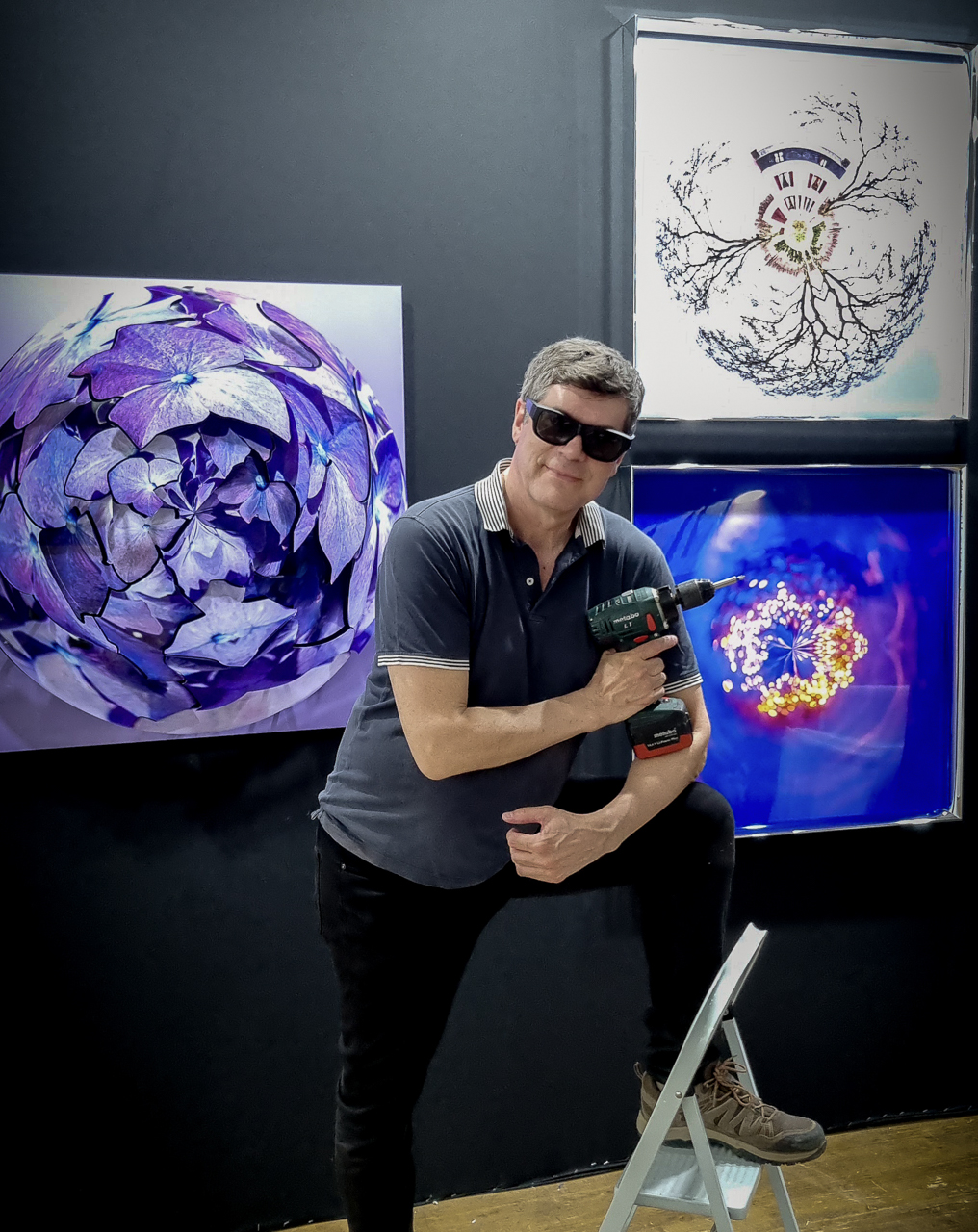
Transforming reality to see things differently
My work begins with reality but does not seek to reproduce it.
A landscape, a tree, a piece of architecture, the sky, a flower, or sometimes a seemingly insignificant detail catches my eye. A quality of light, a shape, a color, or a composition holds my attention. Photography then becomes the starting point for a process of transformation.
With my *Imaginary Planets*, I aim to shift perspectives—to reveal a different world emerging from what already exists. It is a world that retains the memory of reality while opening the door to the imagination.
Some of my creations remain figurative. Others gradually drift away from their origins, bordering on abstraction. It is precisely this intermediate space that interests me: the place where one recognizes something without always being able to say immediately what it is one is looking at.

L’Étreinte des Cimes
My Artistic Intent
Through my work, I seek first and foremost to surprise and to evoke a sense of wonder.
Transforming a landscape, a tree, a piece of architecture, or a fragment of everyday life can reveal things that familiarity often blinds us to. The familiar becomes strange. A known place transforms into an imaginary realm. A photograph can thus open up a space where each viewer constructs their own interpretation.
I also like my images to challenge the way we look at things.
What do we actually see? Where does the photograph end and the transformation begin? Are we looking at a landscape, or have we already entered the realm of abstraction?
That moment of hesitation interests me. It invites the viewer not merely to recognize an image, but to take the time to explore it.
I also embrace beauty, poetry, and a sense of lightness.
In a world saturated with images—and often defined by urgency and anxiety—I love the idea that my creations can offer a moment of respite. That they might spark surprise, emotion, a smile, or simply the pleasure of looking.
This pursuit of beauty does not preclude questioning or a sense of the uncanny; on the contrary, it is one of the paths I take to shift our perception of reality.
Ultimately, creating an "Imaginary Planet" means starting with what already exists and attempting to draw something unexpected from it: a world that is at once familiar and impossible—capable of surprising, questioning, and, perhaps, inspiring wonder.
Reality as a starting point
Even when the final image appears unreal or almost abstract, its origin remains photographic.
I always begin with a photograph. Behind every creation, therefore, lies a place I encountered, a specific light, a season, a moment, or sometimes simply a detail that caught my eye.
This connection to reality is important to me.
It gives each "Planet" a story, even when that story is no longer immediately apparent in the final image.
However, I do not always photograph with a precise idea of the outcome. Sometimes I recognize a scene’s potential immediately. Yet, certain photographs may sit in my archives for a long time before revealing a possibility for transformation.
An image captured almost by chance can thus become, months later, the starting point for a new creation.

The Lonely Tree Revisited
Transforming rather than reproducing
Once the photograph has been taken, another stage begins.
The image gradually becomes raw material for creation.
I transform perspectives. I curve lines. I bring elements closer together or push them further apart. I explore the rhythms, colors, balances, and tensions that emerge during the process.
I am not simply trying to apply a technique.
Each photograph reacts differently to the transformation. Some directions work; others do not. It requires experimentation—retracing steps, starting over, and sometimes abandoning one path to discover another.
Little by little, the original image ceases to be merely descriptive.
A landscape is no longer just a landscape. Architecture can become a shape. A tree can transform into a graphic structure. A sky can become texture.
That is the moment when, for me, the photograph begins to open up a different kind of space.

Étrange Chemin
The Circle as a Language
The circular form naturally holds a central place in my work.
Initially, it was linked to panoramic photography and the transformations that gave rise to my first *Imaginary Planets*.
But over the years, the circle has become far more than just a technique.
It has become a visual language.
The circle disrupts our habitual way of viewing a landscape. The horizon vanishes or folds back upon itself. Up and down become relative. The eye is drawn toward a center, then moves back outward.
This form can evoke a planet, but also an eye, a cell, an orbit, an organism, or simply a self-contained space.
I do not seek to impose an interpretation.
On the contrary, I like to leave the form open to the viewer's imagination.
Each *Planet* thus creates its own balance, its own space, and sometimes even its own laws.

Sunflowers Galaxy

The Eye of the Mount

In Between Worlds
Between Figuration and Abstraction
This boundary between the real and the abstract has gradually become one of the most stimulating areas of my exploration.
Some works still allow their origins to be immediately identified; a tree, a mountain, a city, or a piece of architecture remains visible.
In other images, the initial subject recedes further into the background.
Lines, textures, colors, and rhythms then take precedence. The image begins to exist independently of the place that gave rise to it.
A recurring question in my work is: how far can I transform reality without completely erasing the memory of it?
I have no desire to provide a definitive answer.
It is precisely this tension that interests me: the moment when the eye thinks it recognizes something, only to doubt; when the photograph seems to shift toward abstraction while retaining a trace of what was originally there.

Rapeseed Cristal
Chance and experimentation
My creative process also leaves significant room for chance.
I might begin a piece with a very specific idea, only to discover—while working—a form or composition I hadn’t anticipated at all.
I am drawn to these visual accidents. They sometimes compel me to abandon my initial concept in favor of the direction suggested by the image itself.
Some pieces come together quickly, while others require numerous attempts. Sometimes, a work remains unfinished for weeks or even months before I feel the urge to pick it up again.
I view these moments of hesitation, experimentation, and detours as integral parts of the creative process.
The final image, therefore, is not always the execution of a pre-existing idea.
It is often the result of a dialogue between what I had imagined and what I discover as I work.
An Evolving Practice
The Imaginary Planets remain at the heart of my universe, yet I never wished to turn them into a static formula.
Over time, this exploration has led me toward black and white, toward increasingly abstract images, and toward the Crystalline Planets, as well as into the realms of relief and augmented reality.
These explorations all stem from the same desire: to continue questioning the transformation of the image and the way it occupies space.
Through relief, the work partially breaks away from the photographic plane to acquire a physical presence.
Conversely, through augmented reality, it can extend into a virtual space, set itself in motion, and offer an immersive experience distinct from that of a still image.
Other printing or presentation techniques offer me further new territories to explore.
I do not view these explorations as a departure from the *Planètes Imaginaires*; rather, they are extensions of them.
The language evolves, but the fundamental question remains the same: what can a photograph become when we choose to look beyond what it depicts?

A little Frozen Delicacy Relief
An invitation to look differently
Finally, I want to give the viewer a significant role.
A work no longer belongs entirely to me once it is being viewed.
Each person might see something different in it, recognize a shape I hadn’t imagined, invent a story, or simply let themselves be carried away by a color, a composition, or a sensation.
This freedom of interpretation is important to me.
I prefer to open doors rather than provide all the answers.
My Imaginary Planets are thus invitations to slow down one’s gaze, to step away for a moment from the familiar, and to accept not identifying everything immediately.
Looking differently. Allowing oneself to be surprised. Questioning what one sees. And making room for beauty, imagination, and wonder.
It is within this space that I wish to continue evolving my work.